Wednesday 18 March – The History of Gloucestershire’s Inland Waterways – Tony Conder
A good crowd gathered on Wednesday 18 March at the Church Rooms to hear Tony Conder speak on Gloucestershire’s Inland Waterways.
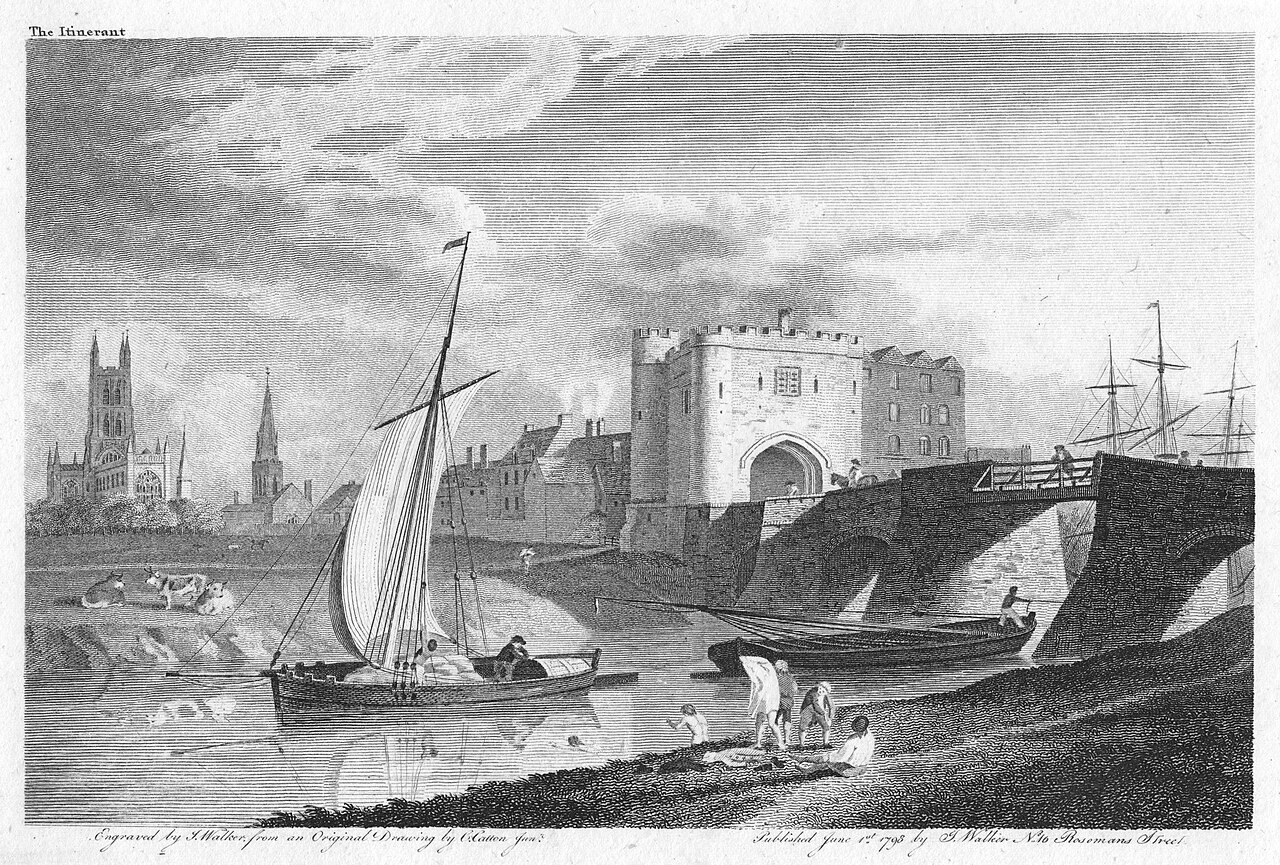
From a drawing by C. Catton, Public domain, via Wikimedia Commons
Tony started by explaining the relatively limited waterways transport in the county that was possible before the coming of the canals in the late 18th century. The main rivers in use were the Severn, the Wye, the Lugg and the Avon. Ships coming up the Severn to Gloucester had to negotiate the tides as well as a series of bends and this resulted in Gloucester being way less developed than Bristol, much further down the river, with Newnham in Severn as the main local port.
Tony went on to describe the many schemes that were proposed across the county for canals to join up existing rivers, make a ship canal to Gloucester and in some cases take waterways where none currently existed. He showed us some of the plans for these that are in Gloucestershire Archives and described some of the reasons why many of them failed. Often this was simply as there was no sufficient water supply to keep a canal full. The first early plans for a Stroudwater Canal were held back by the objections of the mill owners and their existing water rights.
An early attempt, known as Kemmett’s Canal, had proposed using cranes at each mill to transship goods rather than having locks, thus getting around the main objections of the mill owners but it proved impractical in operation and was not completed.
The next attempt proposed to use new canal sections to bypass the mills rather than simply making river improvements and it was given approval in 1774. Finally in 1779 the 8 miles and 12 locks of the Stroudwater Canal were constructed and the canal was opened. A further Act was passed in1783 to construct the rest of the east-west link between the Thames and the Severn and by 1785 it had reached Chalford. Connection to the Thames itself took a little longer as the Sapperton Tunnel had to be built first, but the link was finally made in 1789.
So-called “canal mania” in the 1790s saw the revival of the proposal to make Gloucester a sea port by constructing a ship canal, of some 16.5 miles in length, with 2 locks. Despite running out of money halfway through, and many arguments between parties with vested interests over the route, it was finally completed after 34 years, emerging into the river at Sharpness. Tony described how this canal changed the nature of the City forever, from a medieval market town to a powerhouse of the Industrial Revolution.
In 1827, the ship canal carried about 100,000 tons of goods, but by 1905 this had risen to over a million tons. Originally built as the Gloucester and Berkeley Canal, today it is known as the Gloucester & Sharpness Canal
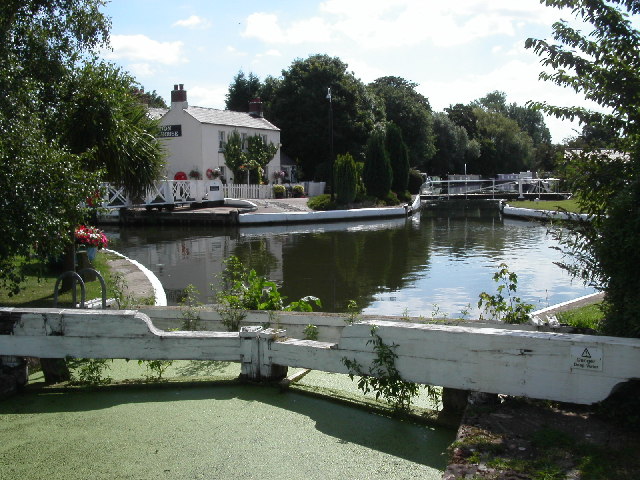
Vincent Jones (Wikimedia Commons)
The Stroudwater and Gloucester & Berkeley Canals cross at Saul Junction, which required some quite clever engineering during the construction of the ship canal as they were at different levels, as Tony explained with maps and plans. It remains the only crossing of two independently owned canals in the country.
Tony then went on to describe improvements made to waterways in the Forest of Dean. Although some improvements were made to the Wye itself, the only canal constructed here was the Hereford & Gloucester. This had several small branch canals, for example to bring in coal from Newent, but most only lasted a few years and were replaced with tramways and roads. We saw some examples of how some of these can still be traced today as lines on the map and faint traces on the ground if you know what you’re looking for.
One way that small branch canals did survive across the county into the twentieth century in some cases, was where they had been constructed to convey produce from a specific facility such as corn from a mill or factory, often on so-called “tub boats” which were little more than large punts. One such named example was Pidcocks Canal which connected an ironworks near Lydney with the Severn itself.
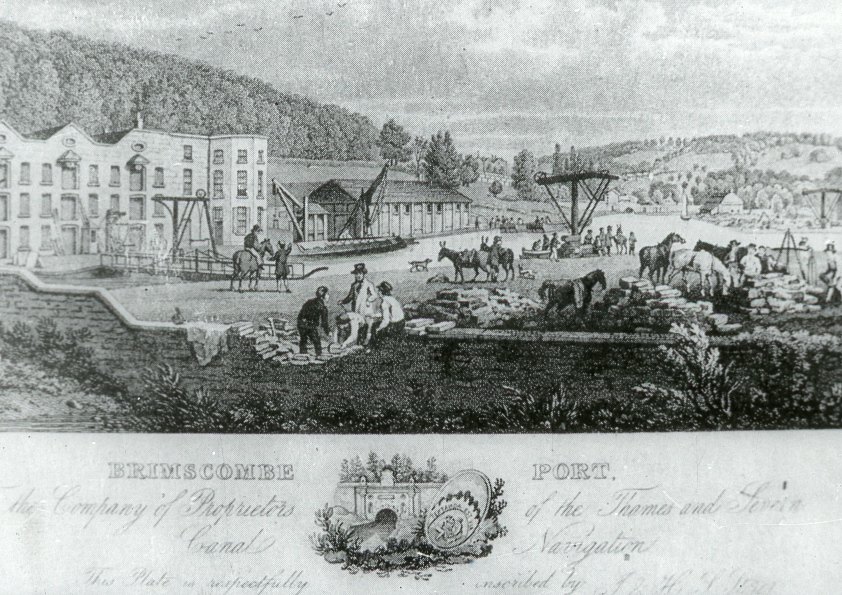
(Mike Mills Collection)
We then heard the stories of a few canals that never were. In the heyday of canals in the late eighteenth and early nineteenth centuries some truly fanciful schemes were put forward and again the drawings for many of these survive today in Gloucestershire Archives. These included the Uley Canal, which had an ambitious plan to use boat lifts instead of locks and the Central Junction canal. Both these ideas failed as there was simply no economic need for them and there was insufficient water supply to make either of them practically viable.
The ultimate decline of the canals is often simply blamed on the coming of the railways, but as Tony explained that is an oversimplification and the real story is more complex. Initially the railways and canals worked together, but then as new factories and mines were constructed, they tended to be aligned with the railways rather than with the canal. Locally, the Thames and Severn had always had water supply problems, and this became worse as time went on. The final death of water transport was caused by the motorways and the growth of road transport.
The efforts to preserve and restore our local canal network started as early as the 1970s and are continued today by the Cotswold Canals Trust. Gloucester Docks itself suffers today from significant issues with silt and the depth in the harbour is no longer sufficient for larger ships. The Canal and River Trust currently has a huge dredging plan to attempt to rectify this.
Tony covered a lot of detail in his talk, and it is impossible to reproduce it all here. If you are interested in knowing more, we recommend the following links as a start.
Canal Life – Stroudwater History
Gloucester & Sharpness Canal | Canal Map
Wednesday 18 February – France Lynch’s Hidden Graveyard – Hilary Burgess, Camilla Boon, Roger Carnt, Heather Collins
Nearly 50 people gathered at the Church Rooms on a freezing Wednesday evening with sleet falling – clearly the subject was of interest!
Five of the Committee – Hilary, Roger, Camilla, Angela and Heather have been exploring and researching the old dissenters’ graveyard at Starry Hill, France Lynch for just over a year now and at this talk, four of them presented the findings so far, and explained the history of the site.
It should be noted that the site is under the care of a charity and is normally kept locked. Please don’t try to enter the site without permission from the charity trustees. Contact us if you are interested in having access at some point.
Hilary began by showing some old maps to pinpoint the location of the site at the end of Keble Road, behind the old bus stop, forgotten and un-noticed by many. She went on to explain the origins of the dissenting movement and the various legislation, first banning and then permitting dissenting meetings. She then covered the origin and history of the site itself. It has gone by various names, with no-one now sure of the origins, but we have called it Starry Hill in this presentation.
The first chapel on the site was probably octagonal or round (no pictures survive) and was built in 1696. It quickly became too small and was replaced in the mid-1700s by a rectangular building further down the site, later known as the Old Vestry (see photo below for where we think this was located). This building was extended around 1750 to build a Sunday school adjacent to the main chapel. By the early 1800s this was also becoming too small – one meeting with a visiting preacher attracted over 3000 people and would probably have been held on the nearby Common – and plans were made for a larger building further up the hill. This became the France Congregational Church – now apartments – built in 1819.
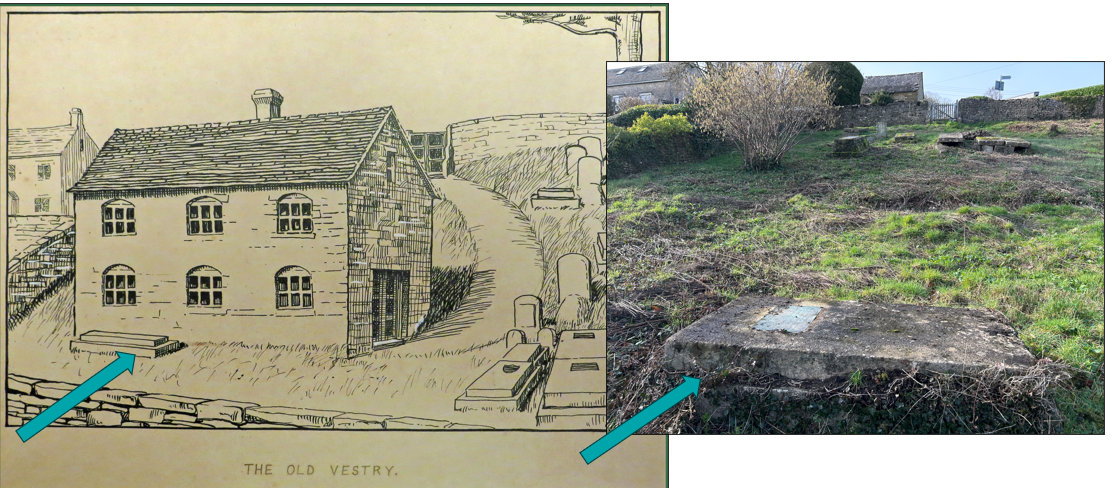
The Old Vestry was demolished so the stone could be re-used for the new building. One of the major benefactors was Charles Ballinger who gave £200, on condition that the Sunday school building on the old site be rebuilt so his family vault, formerly under their pew inside the chapel, remained inside a building.
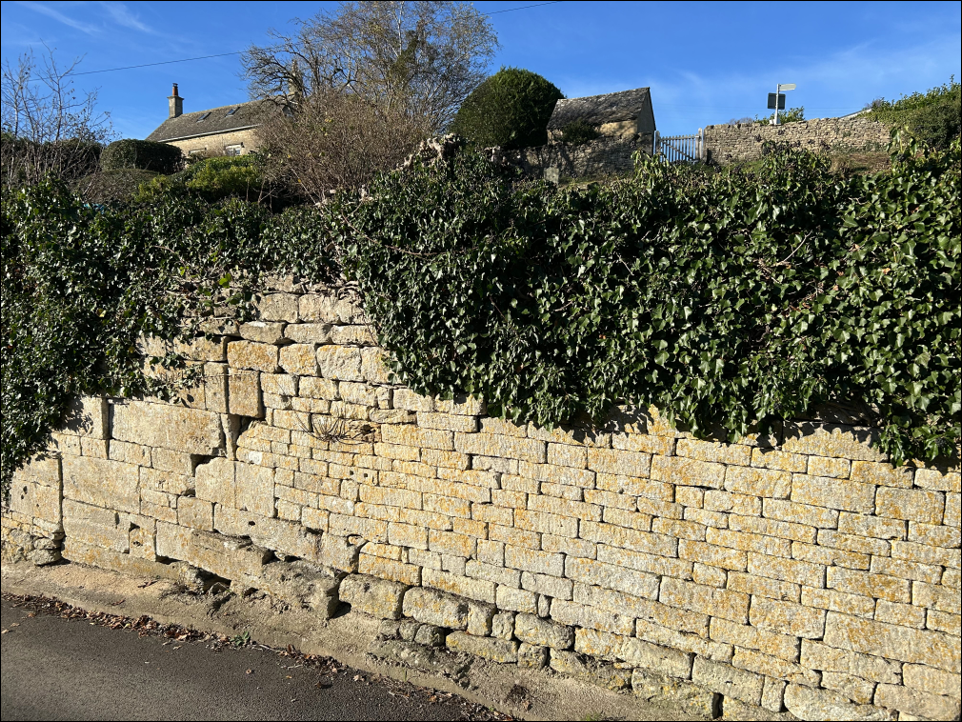
The old graveyard continued to be used throughout the 19th century, and the Sunday school was also used until the 1870s, when it too was demolished, the large, dressed stones being re-used for walls both around the old and new sites, where they can still be seen today.
Heather and Camilla each expanded on the story of one of the wealthy clothier families that became associated with the various chapels, Ballingers and Innells.
The Ballingers came to Chalford in the 18th century and quickly became major landowners, buying property from the Tayloes amongst others. At one point they owned what is now Belvedere Mill (then known as Ballingers) as well as Skaiteshill House, Frith Wood and numerous other properties besides. Ballinger bequests also set up charities that still exist and give grants today.
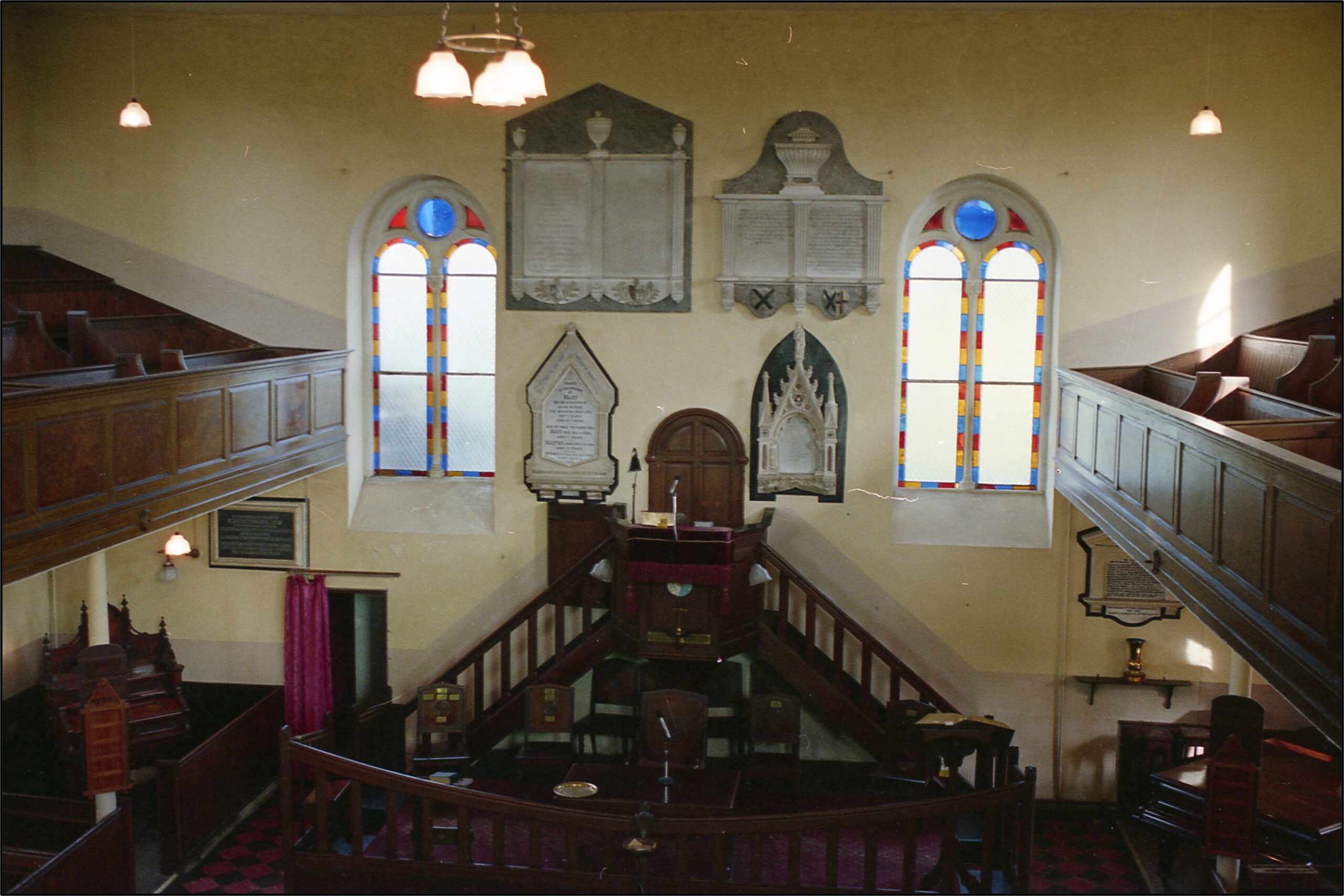
The Ballinger vault in the Old Vestry had five family burials mostly from the last quarter of the 1700s. There was also a rather splendid plaque on the wall giving all their details. The plaque was moved to the new Congregational Church in 1819 and is still in the common area of the building, but the fate of the vault is unknown and remains one of the mysteries of the site. The condition of the present day surface makes it impossible to see where it might be, although the location of the Old Vestry building seems fairly clear (see photos above with blue arrows)
The Innell family were also significant landowners and Camilla showed us some plans drawn when the canal route was proposed that named several Innells as adjacent landowners. John and Mary Innell lived at Green Court, and their son James probably added the façade in around 1810. James’s son John was declared bankrupt in the 1820s and this seems to have brought a halt to the family burials on the site.
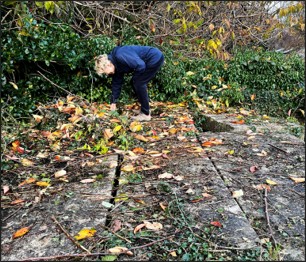
The Innell family vault in the graveyard was above ground and is still clearly visible today as a very solid structure with internal chambers. The Innell plaque, which like the Ballinger one was moved to the new chapel and still survives on the wall, mentions John and Mary and two of their sons, but it isn’t clear who was actually buried in the vault. Only one name is inscribed on the vault, “J Innell 1806”, which would fit with the death of the oldest son John. The rest of the family names, James included, were never added to the vault and the later names were not added to the plaque, probably due to the bankruptcy. From what can be seen inside the vault today looking through gaps in the outer wall, it appears empty and it is uncertain how many burials were actually made within it, or what happened to them. Unfortunately the surviving burials records are rather poor and unhelpful.
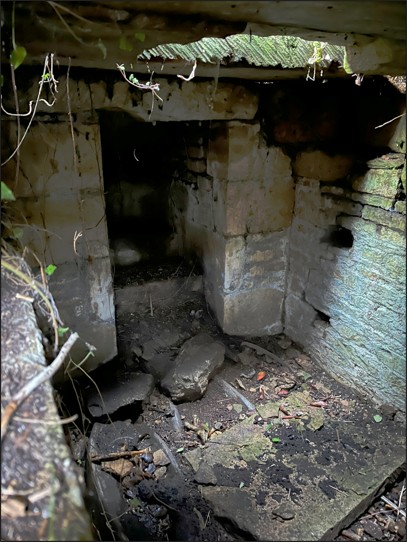
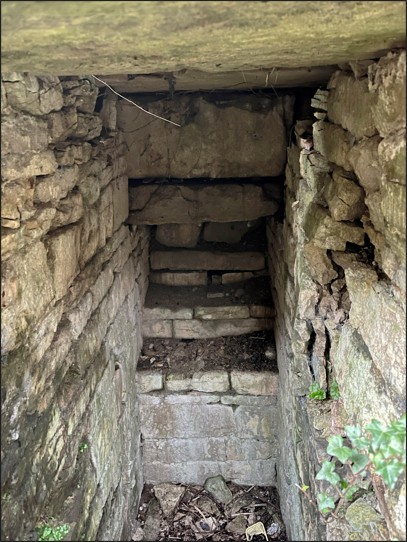
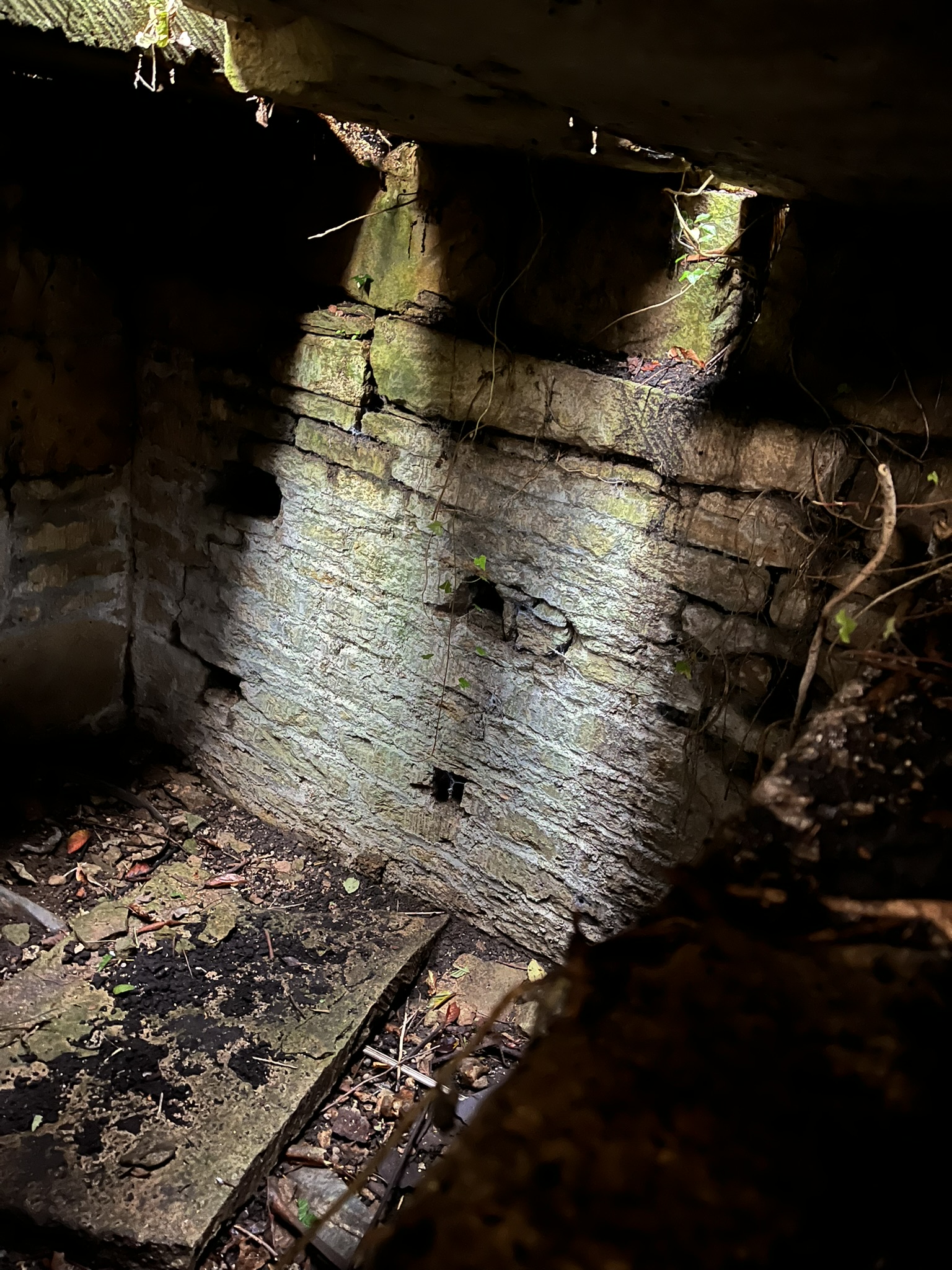
Roger and Hilary then recounted the stories behind a number of the other graves that have readable inscriptions. In researching these, we were greatly aided by a document of transcriptions made in the 1960s by a genealogical researcher, David Gardner, on behalf of the Church of Latter Day Saints. Even in the 60s, Gardner noted that some inscriptions were barely legible and other graves appeared to have never had any inscription at all. Some of the examples covered in the presentation included:
Aaron and Mary Lord. An elderly brother and sister who died in a fire in their cottage at Hyde in 1795. Aaron had inherited £2000 some years before – an enormous sum for an ordinary person at the time. He had however lived a most frugal life, commenting on being offered some cheese to eat with his bread that, “Cheese was a luxury that led men to eat more bread than was necessary.” He was said to have increased his fortune to around £4000 and some of the money was “dug out” of the cottage. A subsequent newspaper article offered a reward for the return of some of the money, which had apparently been stolen after the fire.
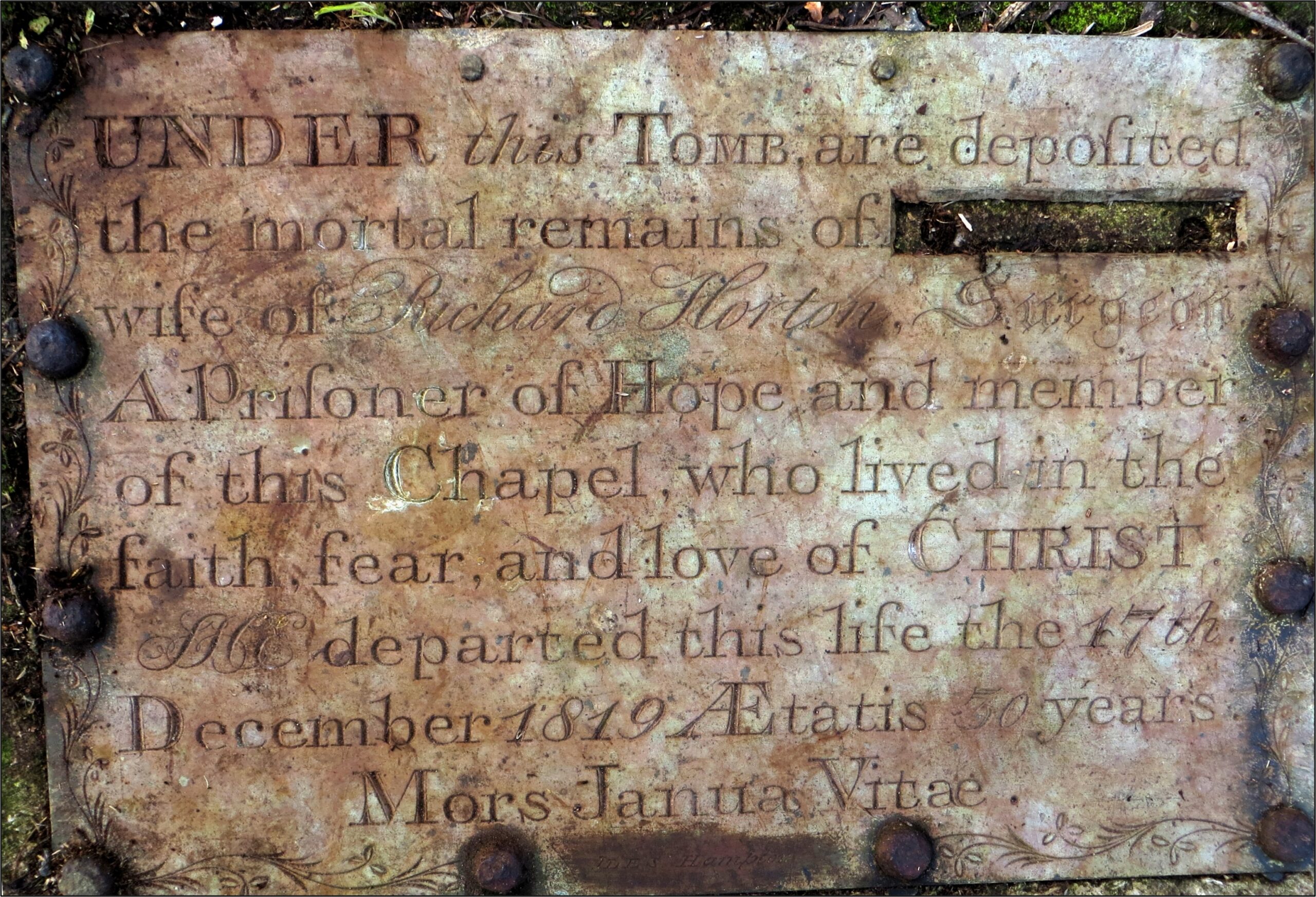
The inscription on the grave of the wife of Richard Horton, surgeon had attracted attention as the wife’s first name appears to have been cut out. Horton married Anne Elizabeth Davies, who then died in 1819. The “space” left by the cut out isn’t big enough for both her forenames, but Anne would probably fit. Horton married again three years after his first wife died. He then applied for letters of administration for Anne’s estate (she had not left a will), seventeen years after her death. Why he left it so late is a mystery we have not solved. Whether it has anything to do with the missing piece on the plaque is also a mystery! Horton died at Alma Villa, Chalford in 1862, burial place currently unknown.
Emily Reap was killed in a stagecoach crash in 1828, when returning home to Devon after staying overnight with the Rev Whitta, then the Minister of the Congregational Chapel. She had known him previously from Tiverton and he was also her executor. The owners of the coach were fined a “deodand” (under an old law which required an object responsible for a death to be forfeit to the crown, or a payment in cash made instead) of £10.
The Drew family. The Drews were a well-known family of local carpenters and builders. Their family grave includes William and Mary Drew, their daughter Ann who died aged 15 and their other daughter Virtue, who after the death of her husband was a grocer and draper. Their son Geroge who built the Chalford Wesleyan Chapel and Vale House was buried in an elaborate tomb in Christ Church.
Originally, we had thought the last burials in this graveyard were in the late 1800s, but the discovery of a newspaper article told us otherwise. The Stroud News reported in 1908 that the burial of George Goodship had taken place in the graveyard, noting that it was “quite a strange event and even the oldest inhabitant of Chalford had never witnessed a similar interment.”
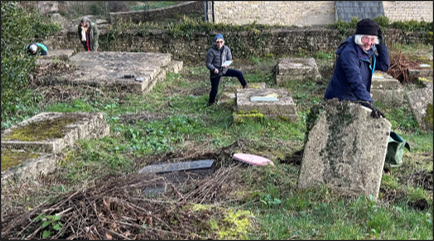
There are still clearly more fascinating stories to tell and potentially other graves to uncover or find inscriptions for, as we have not yet found all the graves that David Gardiner found in the 60s. Some inscriptions may have been eroded by time, especially where they were not on metal plaques, but we also have not solved the mystery of the Ballinger vault or why the Innell vault appears empty.
As a postscript several of the longer term residents of France Lynch recalled exploring the graveyard as children when it was more accessible, and either seeing skulls or finding bones, including one story of a skull being brought into school and another of a dog coming home with a bone!
We hope to present more detail of these findings along with further pictures at our planned drop in afternoon on Saturday 3 October – further details to follow.
Wednesday 21 January – MOD War Detectives – Alexia Clark
A good crowd on a miserable rainy Wednesday evening to hear Alexia Clark talk about the work of the MOD War Detectives based at Imjin Barracks in Gloucester.
Alexia began by telling us about the work of the MOD’s Joint Casualty and Compassionate Centre (JCCC), which the Commemorations Team – the War Detectives – is a part of. More details here
The team’s main aim is to identify the missing British casualties of the two World Wars and the Korean War. To put this into context, around 1.2 million British military personnel were killed in WWI and nearly 527,000 have no known grave. Of these, around 184,000 are buried in graves with no name on the headstone (“Known to God”). The figure does include those lost at sea, but it’s still a staggering number for those with no known resting place and was a source of great distress to many families at the time.
Alexia briefly explained how the battlefields were cleared and the bodies of the dead recovered from temporary wartime cemeteries and concentrated in larger cemeteries by the Graves Registration Units after WWI ended. This was a meticulous process involving the use of grid searching using wartime trench maps, the recovery of artefacts (such as badges, buttons, military equipment and personal possessions) that might help to identify the casualty, and detailed recording. This article gives some further details of what happened when a soldier was killed and how the battlefields were cleared What happened to a soldier who died? – The Long, Long Trail
© Crown Copyright
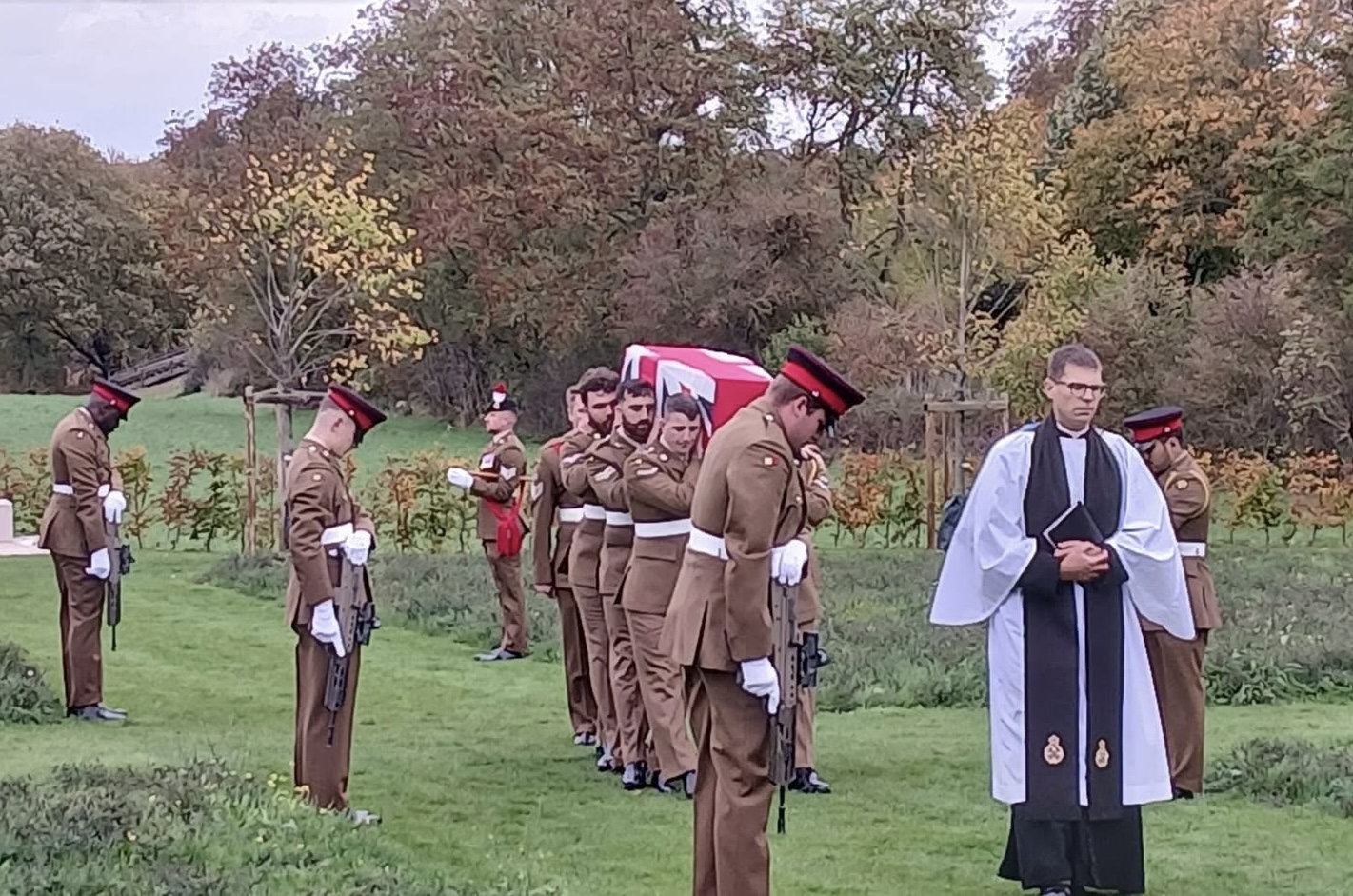
Private Arthur Cook, Private Robert Cullum, Private John Fraser and Private William London were all from Grimsby originally, and though they came to army service at different times, they all found themselves part of the final days of the Battle of Arras in May 1917. All four men were part of the same Lewis Gun Crew, and they died together on 5 May 1917 – Fred Blakey MM was the fifth member of the crew, and he survived albeit severely wounded. Ptes Cook, Cullum, Fraser and London were listed as missing, and following the war their names were added to the Arras Memorial. A full military funeral for the men was held in October 2025, led by Padre Joe Roberts of 1st Bn The Royal Anglian Regiment (the successor unit to the Lincolns), and the bearer party and firing party were also made up of serving soldiers from 1st Bn The Royal Anglians. Artefacts such as shoulder titles that had been found with the men were presented to the families. New headstones with the names and inscriptions chosen by the families have been erected by the Commonwealth War Graves Commission (CWGC).
© Crown Copyright
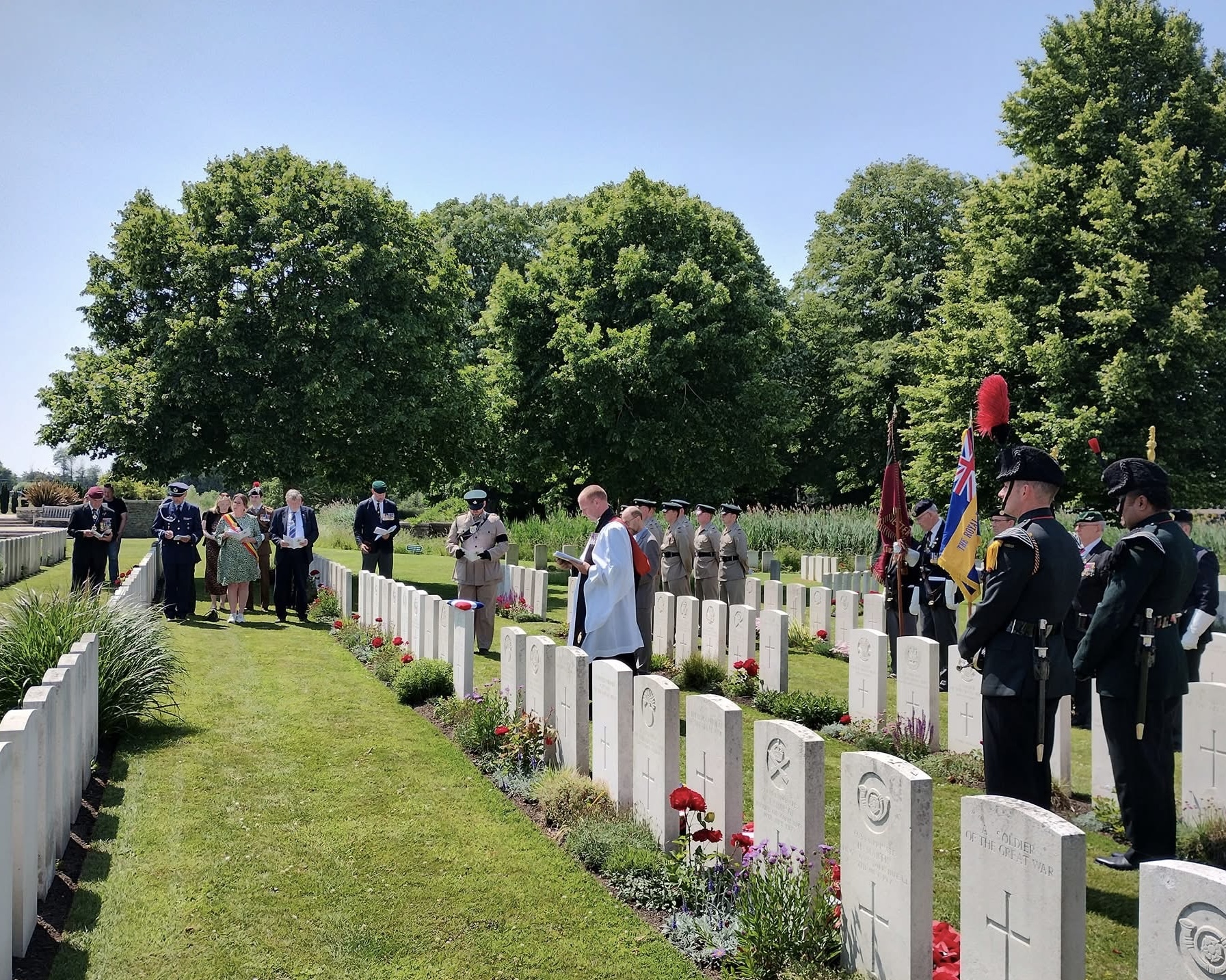
Captain Ernest Blencowe of the Dorsetshire Regiment, died defending The Bluff in February 1916. His grave was rededicated in June 2025, with a new headstone in the presence of two of his great-grandchildren, accompanied by a young historian who has studied the regiment and Captain Blencowe’s story extensively. The service was held (as those in Belgium apparently usually are) in the presence of a large crowd including the Mayor of Ieper, the Belgian Defence Force and the Royal British Legion. It was led by Padre John Storey of 5th Bn The Rifles (successor Regiment to the Dorsets, who by coincidence had attended the same school as Captain Blencowe) and supported by serving personnel from 1st Bn The Rifles who flew in specially from Cyprus for the occasion. Buglers from The Band and Bugles of The Rifles were also present.